No words, no surprises...
Here’s one way to look at the politics of our era: We’ve moved from The Age of Leverage to The Great Unwinding.
For about a generation, the U.S. surfed on a growing wave of debt. The ratio of debt-to-personal-disposable income was 55 percent in 1960. Since then, it has more than doubled, reaching 133 percent in 2007. Total credit market debt — throwing in corporate, financial and other borrowing — has risen apace, surging from 143 percent of G.D.P. in 1951 to 350 percent of G.D.P. last year.
Charts that mark these trends are truly horrifying. There is a steady level of debt through most of the 20th century, until the mid-1980s. Then there is a steep accelerating rise to today’s epic levels.
This rise in debt fueled a consumption binge. Consumption as a share of G.D.P. stood at around 62 percent in the mid-1960s, and rose to about 73 percent by 2008. The baby boomers enjoyed an incredible spending binge. Meanwhile the Chinese, Japanese and European economies became reliant on the overextended U.S. consumer. It couldn’t last.
The leverage wave crashed last fall. Facing the possibility of systemic collapse, the government stepped in and replaced private borrowing with public borrowing. The Federal Reserve printed money at incredible rates, and federal spending ballooned. In 2007, the federal deficit was 1.2 percent of G.D.P. Two years later, it’s at 13 percent.
The crisis response more or less worked. Historians will argue about the Paulson-Geithner-Bernanke reaction, but the economy seems to be stabilizing. And now attention turns to the task of the next decade: slowly unwinding the debt that has built up over the past generation.
Americans aren’t borrowing the way they used to, but the accumulated debt is still there. Over the next many years, Americans will have to save more and borrow less. The American economy will have to transition from an economy based on consumption and imports to an economy with a greater balance of business investment and production. A country that has become accustomed to reasonably fast growth and frothy affluence will probably have to adjust to slower growth and less retail fizz.
The economic challenges will be hard. Reuven Glick and Kevin J. Lansing of the San Francisco Fed estimate that Americans will have to increase their household savings rate from 4 percent to 10 percent by 2018 to restore balance. That, they write, will produce “a near-term drag on overall economic activity.” Meanwhile, capital and labor will have to flow from sectors that depend on discretionary consumption to sectors based on research and investment.
But it’s the political challenges that will be most hellacious. Basically, everything that a politician might do to make voters happier in the near term will have horrible long-term consequences. Stimulate the economy too much now and you wind up with ruinous inflation down the road. Preserve failing companies and you wind up with Japanese stagnation. Cushion the decline in living standards with easy money now and you just move from a housing bubble to a commodities bubble.
The members of the political class face a set of monumental tasks. First, they have to persuade a country to postpone gratification for the sake of rebuilding the country. This country hasn’t accepted sacrifice in 50 years.
Second, political leaders will have to raise taxes and cut spending to get the federal fiscal house in order, and they will have to do it at a time when voters are already scaling back their lifestyles.
Third, they will have to refrain from doing anything that might further damage America’s fiscal position, which is extremely fragile. That means not passing a health care reform package unless it is really and truly paid for. That means forming a Social Security commission next year to tackle that entitlement problem.
Fourth, the political class is going to attempt the politically unthinkable. The U.S. is going to have to move toward a consumption tax, to discourage spending and encourage savings. There’s also a crying need for tax reform. As economist Douglas Holtz-Eakin points out, the tax code is rife with provisions that encourage leverage and discourage investment. The government will have to spend less on transfer payments and more on investments in science and infrastructure.
The members of the Obama administration fully understand this and are brimming with good ideas about how to move from a bubble economy to an investment economy. Finding a political strategy to accomplish this, however, is proving to be very difficult. And getting Congress to move in this direction might be impossible.
Congressional leaders have been fixated on short-term conventional priorities throughout this entire episode. There is no evidence that the power brokers understand the fundamental transition ahead. They are practicing the same self-indulgence that got us into this mess.

For the first time, investors can include single-family housing as an asset class in their portfolios.
During a Webinar Wednesday sponsored by Financial Advisor Magazine and Index Universe, speaker Robert Shiller mentioned that next week two New York Stock Exchange -traded investment products will be launched by MacroShares. Up Major Metro Housing, or UMM, and Down Major Market Housing, or DMM, are inventions patented by Shiller, the creator of the Case-Shiller home price indices. The products will follow, but not replicate in market price, the Case-Shiller Composite 10 home price index, an index that tracks the single-family resale housing markets in 10 major U.S. metropolitan areas.
For those who don't own, and don't intend to own, their own home these products allow exposure to an asset class with low correlation to many asset classes and negative correlation to bonds. For those who own their own home, but are over-allocated to that investment in their overall portfolio, it allows, with DMM, a hedging position to be established against declining home prices. For those that intend to buy a home, but are worried about increasing prices, that risk can be hedged via UMM.
The two investments will constitute portfolios consisting of U.S. Treasury securities invested in trusts of equal initial value on the day of introduction. The duration of the trusts will be five years from the initial offering date. The net asset value of each fund will be adjusted by transfer of assets between the funds as the supporting index changes. The index is reported monthly as a three-month moving average, with a delay of nearly two months. The two funds will have trading characteristics similar to closed-end funds, in that they can trade at premiums or discounts to net asset value, or NAV.
The two funds will operate with a leverage ratio of 3 to movement of the Composite-10 index. Thus, if the index moves up 2%, UMM will receive 6% of the assets from DMM. The NAVs will change accordingly, but the trading prices will change by an amount that differs from NAVs by the current premium or discount. Obviously, the pair of trusts is limited in how far they can follow the index because of the leverage. For example, a 35% change in the index would require a transfer of 105% of assets, which is impossible. Therefore, there must be an early termination condition (before the five-year intended maturity) if the index makes a sufficiently large move.
An example of a possible early termination would be a 25% change in the index from the initial trading day. With three times leverage, one of the trusts would then have added 75% to the initial NAV and the opposite trading pair would have lost 75% of NAV. The actual trading values of the trusts should see premiums or discounts move near zero as the termination limit approaches (either five years or early termination condition), because the termination distributions will be at NAV.
After the webinar, I developed some examples of how these new products might be used.
Example 1. Consider a homeowner, with no mortgage, who has $400,000 of equity in his home. The rest of his assets (regular savings and retirement accounts) consist of a variety of investments in other asset classes and total $600,000. This individual wants to reduce the 40% allocation to his home to 20%. This can be accomplished by buying 667 shares of DMM, if the market price and the NAV is $100, using part of his $600,000 of non-residential housing real estate. Remember the three times leverage: 667 x 3 x $100 = $200,000. This establishes a long position of $400,000 on his house and $200,000 short on the home price index, or a net of $200,000 long on residential real estate. The balance of his investment assets are now reduced by $66,700 (667 shares x $100) to $533,300.
The offset won't be perfect. Real estate is always a local market and most of the time no local market is likely to be aligned exactly with the 10-city composite index. Also, the numbers used assumed that UMM was acquired and sold at NAV (no premium or discount).
Our homeowner has hedged his over-allocation to his residence. If, after five years, the market value of his home is $480,000, and the Composite-10 index has also increased by 20%, his net position becomes $480,000 long (house value) and a short position value of $27,080 (677 x [$100 - (3 x $20)]). He has lost $40,620 on the hedge and made $80,000 on the house, for a net gain of $39,380.
Our homeowner has given up more than half of the gain in the market value of his house. Why would he do that? Let's look at a second example.
Example 2. The same homeowner enters the same financial arrangement as in the first example. In this example, his home loses 20% of market value after five years. Now the final numbers are: home value $320,000 and DMM value of $108,320 (677 x [$100 + (3 x $20)]). He has made $40,620 on the hedge and lost $80,000 on the house, for a net loss of $39,380.
Our homeowner gave up the potential for a larger gain to protect against the potential for a larger loss. Note that if the house and the Composite-10 index are unchanged after five years, the balance sheet is unchanged.
In these examples, we've ignored the operating costs of DMM, which would subtract from the final net of the position.
Example 3. In this case we consider a prospective homeowner, who, for some reason, isn't ready to buy right now but does have some savings intended for an eventual home purchase. Let's assume these savings are $70,000 and the prospective purchase date is three years. If the prospective homeowner wants to lock in his current financial position, he can accomplish that using UMM. Again, we'll assume a hypothetical market price and NAV of $100. The future homebuyer can buy 700 shares of UMM.
If the price of his intended home purchase rises by 15% in three years, the value of UMM will increase by a factor of 1.45 (1 + [3 x .15]). Again, remember this assumes the intended purchase may not change in value by exactly the same amount as the Composite 10 index.
So, if the house he intended to purchase was originally $280,000, the market value after three years will be $322,000 ($280,000 x 1.15). At the same time, UMM will have an NAV of $145 and the 700-share position would have a value of $101,500. The prospective buyer has protected his buying power in a rising market. In fact, the $101,500 now allows a larger down payment (31%), more than the 25% of three years earlier.
Example 4. Consider the same buyer as in the third example, but this situation sees the market drop 15%. The intended house purchase will now be priced at $238,000 ($280,000 x .85). The value of UMM will be reduced to $38,500 (55% of the original investment). The down payment will now only be 16% of the purchase, compared with 25% originally. To get to 20% down, our buyer will have to buy for $192,500.
The use of UMM works better as a hedge to preserve purchasing power in a rising market than in a declining market. The one consideration I offer is that buying a house below asking price is much more likely in a falling market than in a rising market, so some of the downside disadvantage of this strategy may be compensated by market forces.
Case studies can be worked out for diversification of assets when part of the equity in a house is mortgaged. The calculations become more complicated because the equity position will change over time as mortgage payments are made.
Shiller suggested that the market premium or discount of these trusts may also have usefulness in assessing the bullishness or bearishness of those involved in the housing markets. Homebuilders, developers and real estate speculators will have an additional tool to assess potential market direction. Of course, these industry participants can also use UMM and DMM to hedge their risks.
Watch for the UMM and DMM trusts. Shiller said they will start trading on the NYSE next week.
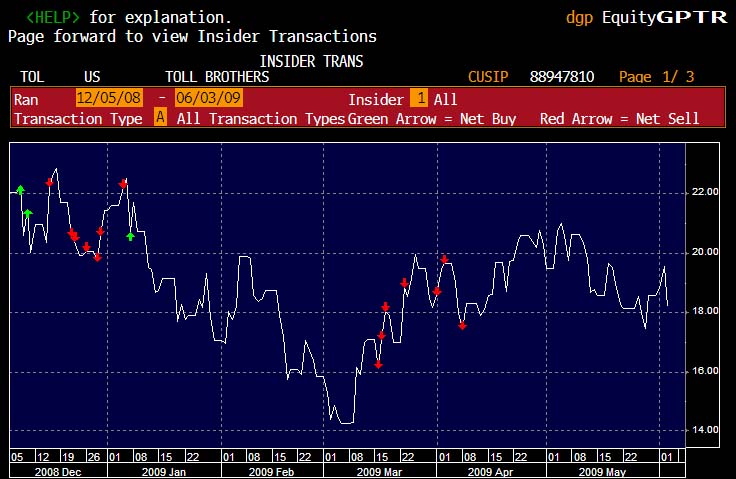
Money talks, and earnings call transcripts walk. At least that is the case for homebuilder Toll Brothers (TOL), whose chairman Bob decided to provide some optimism during his Q1 2009 earnings call and then proceeded to dump stock not once, not twice, but seven times in a span of one month.
We have to take advantage of opportunities we believe will arise from the current downturn. We’re beginning to see some properties come to market at reasonable prices. We have not bought any yet, but we are getting closer. Ironically now is a very good time to buy a home with the decline in home prices and historically low mortgage rates, home price affordability is at an all time high according to the National Association of Realtors.
Ironically, it is an even better opportunity it seems to buy other property with proceeds from selling your own stock in the most insane short covering rally ever, eh Bob? One has to hand it to him though, he can sure see the forest for the green shoots.
Just in case it is not obvious, the red arrows indicate where Bob decided to call it a day...over and over...